
ELIMINATION OF OXIDE TRANSPORT PROBLEMS
Through isolation of the Anode, Anodamine provides protection and stability to base metal and oxides, thus elimininating oxide transport problems.
In most conventional FFA multi-component formulations, if not all, neutralizing and/or alkalizing amines amines are utilized for product stability, solubility and pH control. There exist numerous studies and published work on the degradation of these amine additives and the acidic degradation products that they form.
Employing these combination amine mixtures in high pressure boilers will inevitably lead to deviations in cycle chemistry compliance, failure to meet OEM guidelines for quality of steam to the turbine and significant increases in CACE, well above the existing limit of 0.2 uS/cm. Some turbine manufacturers are now calling for more strict CACE guidelines to reduce this to < 0.15 uS/cm.
The organic acids that are produced and that will pollute the high temperature steam water cycle can be varied, but typically are predominantly acetic and formic acids. Figure 1 shows the very high thermal percentage degradation level for each of the most common neutralizing/alkalizing amines at various pressures. Temperature was the predominant factor affecting degradation.
It would be of value to the engineer and chemist to calculate the acids produced on the measured CACE and hence one’s level of compliance with the international and OEM standards, when using a mixture of film-forming, neutralizing/alkalizing amines, as there is an impact of acidic degradation products in a high pressure installations, with a super heater temperature > 500 °C.
Ammonia is the only alkalizing agent that offers little risk and insignificant degradation, hence it remains the only alkalizing agent of choice for most Anodamine high pressure formulations.
This pollution of the steam water cycle is compounded by boiler cycles of concentration and the accumulation and concentration of these acidic species in the early condensate, PTZ and liquid film 2 phase locations. In many cases, the concentration of these contaminants can exceed 150 -250 X the original concentration as measured in the bulk steam, thus leading to significant concentrations of acids in contact with metal and oxides.
These acidic degradation products have highly reactive functionalities. The acids are known to act as chelants, to complex and increase transport of iron. The accumulation of organic acids and concentrating mechanisms of the same can also directly interact at temperature with not only oxides but with the film forming amines themselves, leading to degradation products, gum balls, fatty deposits and fouling of orifice plates, feed water strainers etc.
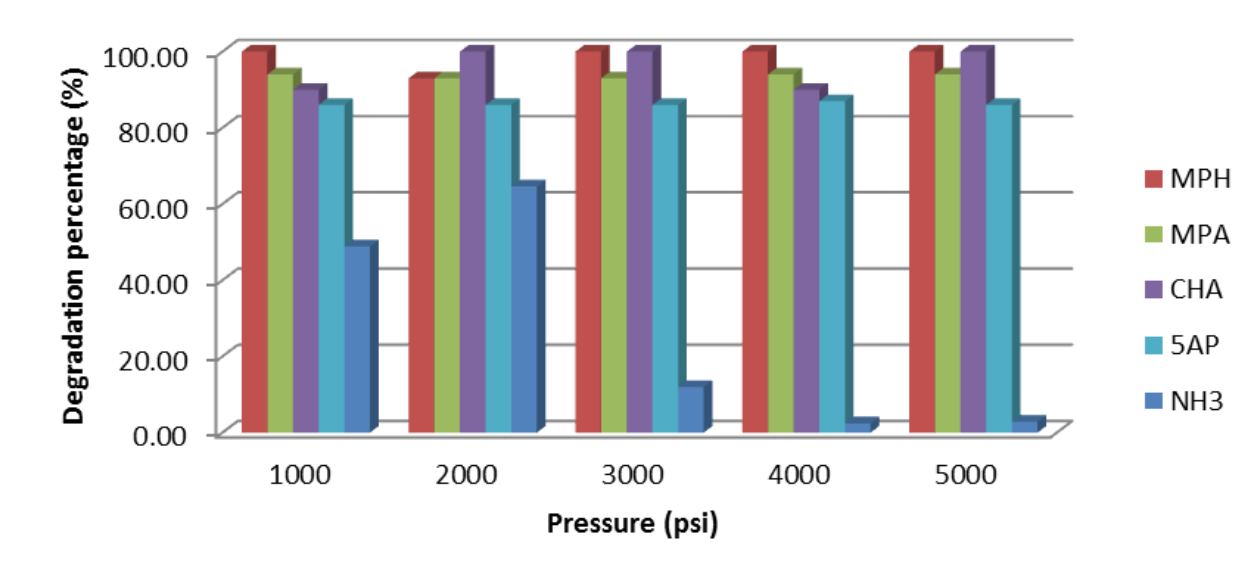
See section under thermal stability. Degradation of common neutralizing amines at 500 °C.
The neutralizing amines are as follows:
- MPH Morpholine
- CHA Cyclohexylamine
- ETA Ethanolamine
- MPA Methoxypropylamine
- 5AP 5-Aminopentanol
- NH3 Ammonia
Anode Isolation
Through isolation of the Anode, Anodamine provides protection and stability to base metal and oxides, thus elimininating oxide transport problems.

References
- Joonyong Lee and Gary L. Foutch. Investigation of Findings on the Thermal Stability of Neutralizing Amines. School of Chemical Engineering, Oklahoma State University